Your three-year-old crumbles into tears because their cracker broke in half. Your six-year-old slams a door after losing a board game. Your eight-year-old says "I hate everything" after a rough day at school. These moments can feel exhausting — but they're actually some of the most important opportunities you'll ever have as a parent.
Each of those reactions is a child trying to process a feeling they don't yet have the tools to handle. And that's exactly where emotional intelligence comes in. Emotional intelligence — sometimes called EQ — is the ability to recognize, understand, and manage one's own emotions, and to empathize with the emotions of others. It's not something children are born with. It's something they learn, and the ages between three and eight are when the foundation is built.
The good news? You don't need a psychology degree to help your child develop emotional intelligence. You just need some practical strategies, a little patience, and the willingness to meet your child where they are.
Why Emotional Intelligence Matters More Than You Think
Research from the American Psychological Association shows that children who manage their emotions well are more likely to do well in school, build healthy friendships, and navigate conflict without aggression. Emotional intelligence isn't just about feelings — it's a predictor of academic success, social competence, and long-term mental health.
According to psychologist Pamela Cole, PhD, at Penn State University, "Emotion regulation calls on so many skills, including attention, planning, cognitive development, and language development." In other words, when you help your child understand their feelings, you're strengthening the same mental muscles they use for learning, problem-solving, and getting along with others.
Children who grow up in homes where emotions are acknowledged and discussed — rather than dismissed or punished — develop stronger self-regulation skills and are better equipped to handle the challenges that come with growing up.
What Emotional Intelligence Looks Like at Each Age
Children develop emotional skills at different rates, but understanding the general milestones can help you set realistic expectations and provide the right kind of support.
Ages 3–4: The Big Feelings Era. At this stage, children are beginning to identify basic emotions like happy, sad, mad, and scared — but they don't yet have the language or self-control to manage them. Meltdowns are frequent and intense because the part of the brain responsible for impulse control (the prefrontal cortex) is still developing. Your child isn't being "bad" when they fall apart over a broken cracker. They're genuinely overwhelmed.
Ages 5–6: The Emerging Vocabulary. Children in this range start to connect emotions to causes: "I'm mad because she took my toy." They can begin to use simple coping strategies — like taking deep breaths or walking away — when guided by an adult. They're also developing empathy, noticing when a friend is sad and sometimes offering comfort. This is a critical window for building emotional vocabulary.
Ages 7–8: The Strategy Builders. By this age, children can think more abstractly about emotions. They understand that people can feel two things at once ("I'm excited about the sleepover but also nervous"). They can start to problem-solve their way through emotional situations with less adult intervention. However, they still need coaching — especially during high-stress moments like peer conflict, academic pressure, or family changes.
Five Strategies That Actually Work
Building emotional intelligence doesn't require special programs or expensive tools. It happens in the everyday moments of family life. Here are five research-backed strategies you can start using today.
1. Name It to Tame It
One of the most powerful things you can do is help your child put words to their feelings. Research from the Gottman Institute shows that children who learn to identify and name their emotions develop stronger self-regulation skills than those who don't. When a child can say "I'm frustrated" instead of throwing a toy, they've taken a significant step toward managing that feeling.
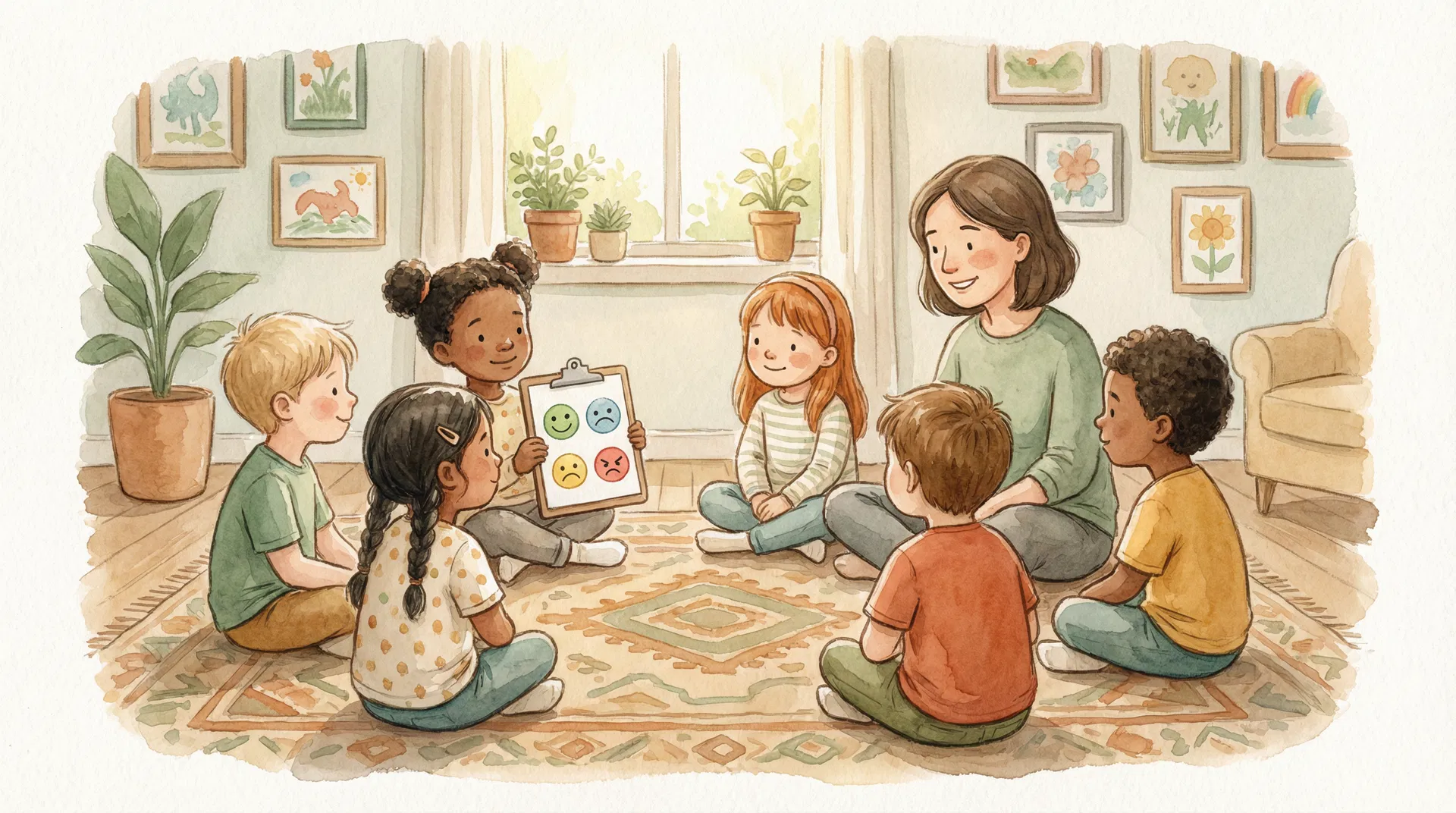
Start by narrating emotions in everyday life: "It looks like you're feeling disappointed that we can't go to the park today." Use books, movies, and real-life situations to point out emotions in others: "How do you think that character is feeling right now?" For younger children, a simple feelings chart with faces can be a helpful visual tool.
The key is to do this when your child is calm — not in the middle of a meltdown. As psychologist Pamela Cole advises, "When things are calm, find opportunities to talk about feelings and strategies for managing them. It won't all sink in during one conversation, but you can lay the groundwork."
2. Model What You Want to See
Children learn far more from what you do than what you say. Alan Kazdin, PhD, director of the Yale Parenting Center, puts it bluntly: when it comes to the old saying "do as I say, not as I do," research shows that's simply not how children work. They watch how you handle frustration, disappointment, and stress — and they mirror it.
This doesn't mean you need to be perfectly calm at all times. In fact, showing your child that adults have big feelings too — and demonstrating how you work through them — is one of the most effective teaching tools available. Try narrating your own emotional process: "I'm feeling really frustrated right now because I burned dinner. I'm going to take a few deep breaths before I figure out what to do next."
When your child sees you manage anger without yelling, handle disappointment without shutting down, and apologize when you make a mistake, they internalize those patterns as normal and achievable.
3. Validate Before You Fix
When your child is upset, the instinct to fix the problem or minimize the feeling is strong. But jumping to "It's not a big deal" or "You're fine" sends the message that their emotions are wrong or unimportant. Instead, start by validating what they feel before moving to solutions.
Validation sounds like: "I can see you're really upset that your tower fell down. That's frustrating when you worked so hard on it." You're not agreeing that the situation is catastrophic — you're acknowledging that their feeling is real and understandable.
Research consistently shows that children who feel emotionally validated are more likely to develop healthy self-regulation skills. When a child knows their feelings are accepted, they feel safe enough to move through them rather than getting stuck.
4. Practice When the Stakes Are Low
The middle of a tantrum is the worst time to teach emotional skills. The best time? When everyone is calm and relaxed. Use role-play, storytelling, and "what would you do?" scenarios to practice emotional problem-solving during quiet moments.
For example: "Let's pretend your friend takes the toy you were playing with. What could you do?" Walk through different options together — ask a grown-up for help, use words to say how you feel, find something else to play with. Then practice acting it out. Kazdin's research at Yale shows that this kind of rehearsal helps children apply new skills in real situations.
You can also use everyday moments as practice opportunities. Waiting in line at the grocery store? Talk about patience. A sibling disagreement? Coach them through using "I feel" statements. The more practice they get in low-pressure situations, the more likely they are to use those skills when emotions run high.
5. Praise the Process, Not Just the Outcome
When your child handles a difficult emotion well — even imperfectly — notice it and name it. "I saw that you were really angry when your sister took your crayon, and you used your words instead of hitting. That took a lot of self-control." This kind of specific, process-focused praise reinforces the behavior you want to see.
Psychologist John Lochman, PhD, at the University of Alabama, emphasizes that harsh punishment for emotional outbursts actually makes behavior worse, not better. His research suggests aiming for four to five positive interactions for every negative correction. Kazdin calls this focusing on "positive opposites" — instead of punishing the behavior you don't want, actively praise the behavior you do want to see in its place.
Simple Activities to Try at Home
Building emotional intelligence doesn't have to feel like a lesson. Here are a few activities that naturally weave EQ development into everyday family life:
Feelings Check-In at Dinner. Go around the table and have each family member share one feeling they had that day and what caused it. This normalizes emotional expression and builds vocabulary. Even a three-year-old can point to a happy or sad face on a chart.
The Calm-Down Corner. Create a cozy space in your home with soft pillows, a few books about feelings, a stuffed animal, and some simple tools like a glitter jar or stress ball. When your child feels overwhelmed, they can go to this space — not as a punishment, but as a choice. Over time, they'll start going there on their own.
Emotion Charades. Take turns acting out different emotions and guessing what they are. This is especially fun for younger children and helps them connect facial expressions and body language to emotional states.
Story Time With a Twist. While reading together, pause and ask: "How do you think this character is feeling? What would you do if you were them?" This builds empathy and perspective-taking skills in a low-pressure, imaginative context.
Breathing Buddies. Have your child lie down and place a stuffed animal on their belly. Ask them to breathe slowly and watch the animal rise and fall. This teaches deep breathing in a concrete, child-friendly way — and it's a strategy they can use anywhere.
When to Seek Professional Support
Every child has emotional struggles — that's a normal part of development. But sometimes, a child may need more support than parents alone can provide. Consider reaching out to a professional if you notice:
- Frequent, intense emotional outbursts that seem disproportionate to the situation and aren't improving over time
- Difficulty recovering from emotional episodes — staying upset for extended periods
- Withdrawal from activities, friends, or family members they previously enjoyed
- Physical complaints (stomachaches, headaches) that seem connected to emotional distress
- Significant changes in sleep, appetite, or behavior at school
- Expressions of hopelessness, excessive worry, or fear that interfere with daily life
These signs don't necessarily mean something is seriously wrong — but they do mean your child could benefit from the guidance of a trained therapist who specializes in working with children. Play therapy, cognitive behavioral therapy (CBT), and other evidence-based approaches can give children the tools they need to understand and manage their emotions in a safe, supportive environment.
You're Building Something That Lasts
The work you do now — naming feelings at the dinner table, taking deep breaths together after a hard day, validating your child's frustration even when the reason seems small — is building a foundation that will serve them for the rest of their lives. Emotional intelligence isn't a destination. It's a skill that grows with practice, patience, and the steady presence of a caring adult.
Your child doesn't need you to be perfect. They need you to be present, to be curious about their inner world, and to show them that every feeling — even the messy, uncomfortable ones — is welcome in your home.
At The Center for Child Development, we work with children and families across Delaware to build exactly these kinds of skills. Whether through play therapy, individual counseling, or family sessions, our clinicians meet children where they are and help them develop the emotional tools they need to thrive. If you'd like to learn more about how we can support your family, we're here to help.
Free Downloadable Checklist
Track your child's emotional intelligence milestones with our printable checklist — organized by age group with parent tips and daily strategies.
Download the Checklist (PDF)Ready to take the next step? Call us at 302-292-1334 or visit our Contact page to learn about the intake process. You can also explore our services to find the right fit for your child.